
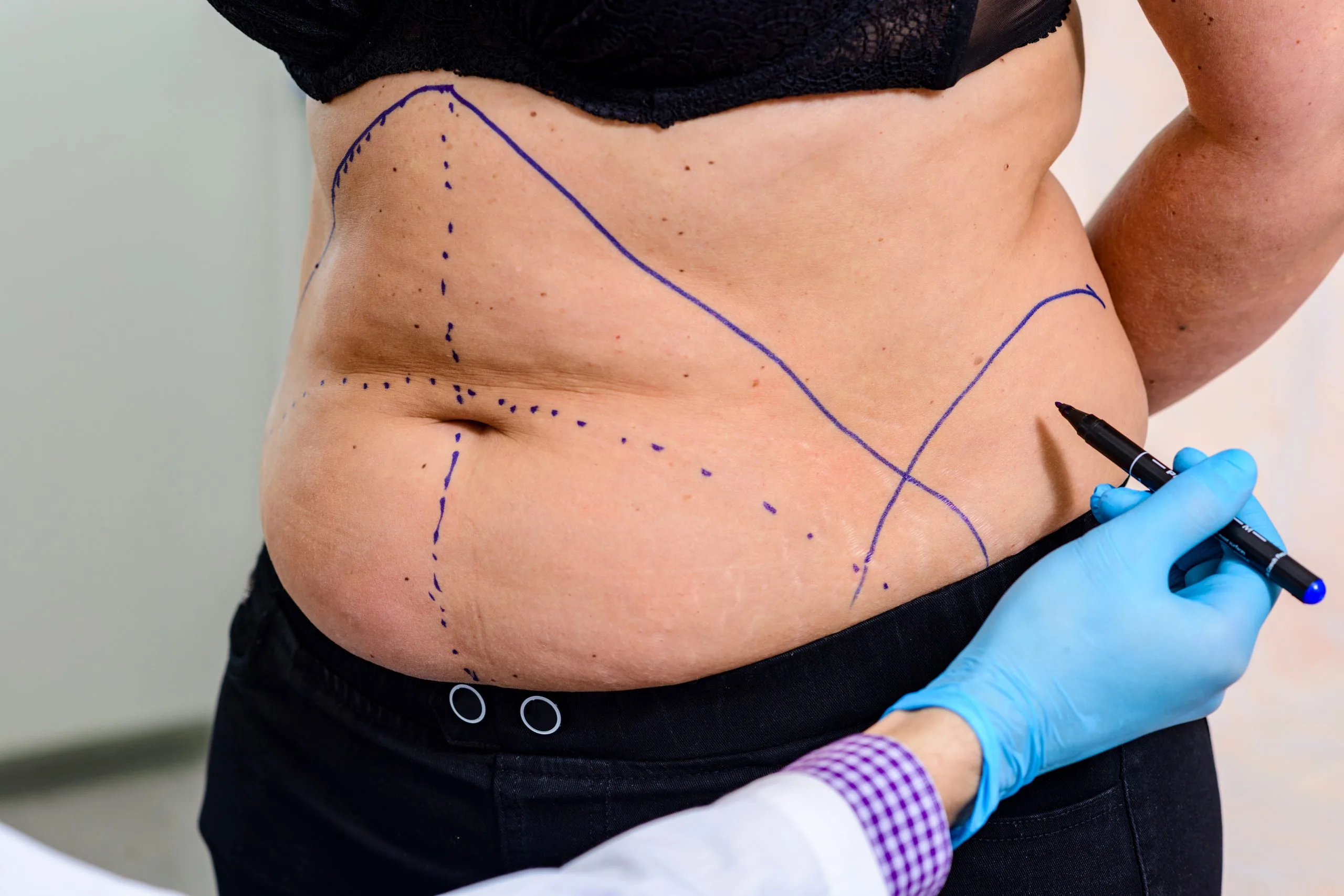
A mini tummy tuck works best when your concern is limited to the area below your belly button, while a full tummy tuck is the better fit when you’re dealing with excess skin, stretched muscles, or laxity that stretches across your entire midsection. The right one for you depends on your anatomy, not your preference.
At Sculpt Cosmetic Surgery in Bluffton, SC, we help patients choose a procedure that actually matches what they’re seeing in the mirror. This guide breaks it down honestly, so you can walk into your consultation already knowing what questions to ask.
What’s Actually Different Between the Two Procedures
The names make it sound like a size difference, but it’s really about scope – how much of your abdomen is addressed and how the underlying muscles are treated.
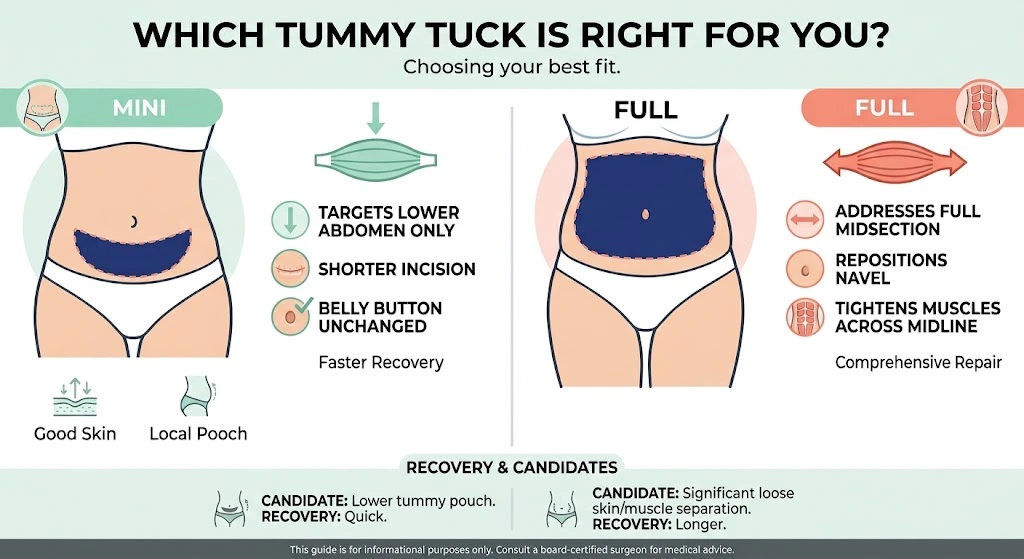
Mini Tummy Tuck
Targets the area below the navel only
Shorter incision, usually hip to hip but lower and less extensive
The belly button typically isn’t repositioned
Often pairs well with liposuction of the abdomen to refine the waistline further
Full Tummy Tuck
Addresses the entire abdomen, above and below the navel
Tightens muscles across the whole midline, not just the lower section
Repositions the belly button to sit naturally on the new contour
Removes more excess skin, which matters most after major weight loss or multiple pregnancies
“I tell patients the mini is like editing one paragraph, and the full is rewriting the whole page,” says Dr. Phillip Crace, cosmetic surgeon at Sculpt Cosmetic Surgery. “Neither one is better. They’re just built for different starting points.”
The Muscle Question Nobody Talks About Enough
Here’s something that gets glossed over in many consultations: the skin isn’t always the main problem. During pregnancy, the abdominal muscles can separate down the middle, a condition called diastasis recti. This is why some people can lose all their baby weight and still have a belly that looks pregnant.
A mini tummy tuck can tighten the lower portion of that muscle wall, but if the separation runs higher up, closer to the ribs, it won’t reach it. A full tummy tuck repairs the muscles along their entire length, which is often the real reason patients say their stomach finally “feels” flat, not just looks it.
“Patients are usually shocked by how much of their core strength comes back after a full muscle repair,” Dr. Crace notes. “It’s not just cosmetic. Some women tell me their lower back pain improved because their core is finally doing its job again.”
Who Tends to Be a Better Fit for Each
Mini Tummy Tuck Candidates
This procedure tends to suit people who:
Have good skin elasticity above the navel already
Are close to their goal weight with a small, localized pooch
Want a quicker recovery and a shorter scar
Haven’t had significant muscle separation
Full Tummy Tuck Candidates
This version tends to suit people who:
Have loose or sagging skin that extends above and below the navel
Have experienced significant weight loss or multiple pregnancies
Have muscle separation running the length of the abdomen
Want the belly button repositioned for a more natural look
If you’ve had children and you’re also unhappy with your breasts sagging or losing volume, it’s worth knowing that many patients combine their tummy tuck with breast work in a single recovery through a mommy makeover. It’s one of the more efficient ways to address multiple post-pregnancy changes at once, rather than spacing out separate surgeries and recoveries.
Recovery: Where the Two Really Diverge
This is often the deciding factor for patients juggling work schedules and childcare.
A mini tummy tuck typically comes with a lighter recovery. Many patients are back to light daily activities within a week to ten days, with full activity resuming over the following few weeks. Because the incision is smaller and the muscle repair is more limited, there’s simply less for your body to heal.
A full tummy tuck asks more of you. Expect to take it easy for the first week or two, avoid lifting anything heavier than a gallon of milk for several weeks, and give your body a few months before you feel fully back to normal. Swelling can linger longer than people expect – it’s common for final results to keep refining themselves for up to six months.
“I always tell patients that the muscle repair, not the skin removal, is what dictates your recovery timeline,” Dr. Crace explains. “Skin heals fast. Muscles need real time to settle back into their new position.”
What This Doesn’t Fix – and What Might
Neither version of this surgery is a weight-loss tool, and it won’t tighten skin on your back or flanks. If your concern extends across your entire torso, it’s worth discussing whether a more comprehensive body-contouring plan makes sense, sometimes combining a tummy tuck with liposuction to smooth adjacent areas. And if a prior surgery left scarring you’re unhappy with, that’s a separate conversation worth having during your consultation – scar revision is sometimes folded into a tummy tuck plan for patients who’ve had previous abdominal procedures.
For patients who aren’t ready for surgery, or who want to maintain results between procedures, non-invasive options for skin tightening and fat reduction can sometimes bridge the gap. It’s a fair question to bring up if you’re weighing your options.
Did You Know?
A few things about tummy tucks that tend to surprise people:
The procedure has roots going back further than most patients guess – surgeons were experimenting with abdominal contouring techniques as far back as the late 1800s, though the modern version we know today didn’t take shape until the 1960s and 70s.
Diastasis recti, the muscle separation many tummy tuck patients have repaired, doesn’t only happen to mothers. Men and women who’ve gained and lost significant weight, or who’ve done years of improper heavy lifting, can develop it too.
Swelling after a full tummy tuck can shift lower in the body as it drains with gravity, which is why some patients notice puffiness near their pubic area weeks after surgery. It’s normal, and it resolves.
Making the Decision With Confidence
The honest truth is that you can’t reliably tell from a mirror alone which procedure your body needs. Skin laxity, muscle separation, and fat distribution all play a role, and they interact differently in each patient.
If you’re ready to find out which path fits your body, we’d welcome the chance to walk you through it in person. You can learn more about the full range of tummy tuck options we offer, or reach out directly to schedule a consultation with Dr. Crace at Sculpt Cosmetic Surgery in Bluffton, SC.
This article is for general informational purposes only and is not a substitute for professional medical advice, diagnosis, or treatment. Every patient’s anatomy and health history are different, and surgical outcomes vary from person to person. Please consult a board-certified surgeon to determine the best options for your individual needs.