

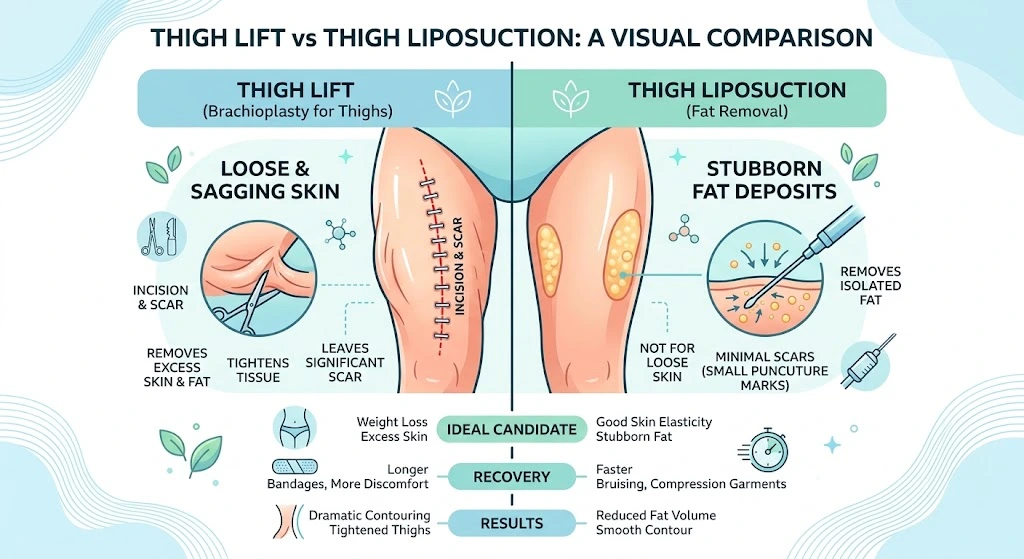
If you’ve spent time researching thigh procedures, you already know the confusion is real. Some pages use “thigh lift” and “thigh liposuction” almost interchangeably, which only makes the decision harder. Here’s the distinction our team shares with almost every patient who sits down in our consultation room: liposuction removes fat, and a thigh lift removes and tightens skin. Most patients need one or the other, not both, and the right choice usually comes down to how your skin behaves, not just how much fat you’re carrying.
“I tell patients all the time – your thighs don’t lie about which procedure they need. The skin tells the story,” says Dr. Phillip Crace, board-certified cosmetic surgeon at Sculpt Cosmetic Surgery in Bluffton, SC. “If you pinch your inner thigh and it springs right back, that’s a lipo conversation. If it stays loose and folds over, that’s a lift conversation.”
That pinch test is a good starting point, but it’s not the whole picture. Age, weight history, skin elasticity, and even genetics all play a role in which approach will actually give you the result you’re picturing. Let’s break down both procedures so you can walk into your consultation already speaking the language.
What Is Thigh Liposuction?
Thigh liposuction is a body contouring procedure that removes stubborn fat deposits from the inner, outer, or front of the thighs using small cannulas inserted through tiny incisions. It’s not a weight loss surgery – it’s a sculpting tool for fat that hasn’t responded to diet or exercise.
Ideal candidates for thigh liposuction usually have:
Good, elastic skin that can shrink back down after fat is removed
Localized fat pockets (saddlebags, inner thigh rub, or a heavier front thigh) rather than overall excess bulk
A stable weight for several months, or ideally years
Realistic expectations – this contours, it doesn’t replace a healthy lifestyle
Dr. Crace performs thigh liposuction as an outpatient procedure, and many patients pair it with treatment in other areas as part of a broader Lipo 360 approach for more comprehensive, all-around contouring.
Recovery Snapshot
Recovery from thigh lipo is generally shorter and gentler than a lift. Most patients wear a compression garment for a few weeks, return to desk work within several days, and see swelling settle over one to three months as the final shape reveals itself.
What Is a Thigh Lift?
A thigh lift, also called a thighplasty, is a surgical procedure that removes excess, sagging skin from the thighs and tightens the remaining tissue. Depending on where the laxity is most pronounced, a surgeon may perform an inner-thigh lift, an outer/bilateral lift, or a more extensive procedure that addresses the entire thigh circumference.
This is the procedure people usually need after:
Significant weight loss, whether from lifestyle changes or bariatric surgery
Pregnancy-related skin changes that never fully bounced back
Natural aging, when collagen and elastin production slow down, and skin loses its snap
A previous liposuction that left behind more loose skin than expected
“Skin doesn’t have the same memory it did at twenty,” Dr. Crace explains. “When someone’s lost a lot of weight, or their skin has simply lost its elasticity over time, taking out fat alone won’t fix the problem. You have to remove the extra skin and re-drape what’s left, or the thigh will still look loose.”
Because a thigh lift involves incision and skin removal, it does leave a scar, typically hidden along the groin crease or inner thigh where it’s easiest to conceal in most clothing and swimwear.
Can You Need Both?
Yes, and it’s actually one of the more common combination requests. If you have both stubborn fat and excess skin, a surgeon may recommend liposuction first to remove volume, followed by a lift to tighten what’s left – sometimes in the same operation, sometimes staged a few months apart depending on your anatomy and safety considerations. This combined approach comes up frequently for patients who’ve had major weight loss and are also addressing their midsection, which is part of why many patients explore this alongside a tummy tuck or full mommy makeover plan rather than treating the thighs in isolation.
How to Know Which One You Need
Here’s a simple self-check you can do before your consultation, though it’s not a replacement for an in-person evaluation:
Sit down and stand up. Watch what your inner thighs do. If skin folds or hangs when you sit, that’s a sign of laxity, not just fat.
Pinch an inch. A firm, springy pinch of fat with skin that snaps back suggests you’re a candidate for liposuction.
Think about your history. Major weight loss (50+ pounds) or multiple pregnancies often shifts the answer toward a lift, even if the “before” photo in your head still pictures a lipo result.
Consider your goals. Are you chasing a smoother silhouette in clothes, or are you bothered by skin that moves independently of your leg when you walk? The first points to lipo, the second points to a lift.
“Patients come in having already Googled themselves into a procedure, and sometimes they’re right,” says Dr. Crace. “But I’d rather spend fifteen extra minutes on the exam table confirming it than send someone into surgery for the wrong fix.”
Did You Know?
A few things about thighs that don’t usually come up in a typical consultation:
Thigh skin elasticity is heavily influenced by genetics, so two people who lose the same amount of weight at the same age can end up needing completely different procedures.
Fat cells removed during liposuction don’t grow back, but the remaining fat cells in untreated areas absolutely can expand if you gain weight later, which is why a stable weight matters so much for lasting results.
Historically, thigh lift techniques date back to the 1950s, but the procedure has changed dramatically since then, with today’s incision placement designed specifically to hide scarring in the body’s natural folds.
What Recovery Actually Feels Like
Patients often ask me to skip the sanitized version and tell them what recovery is really like. For liposuction, expect tightness and soreness more than sharp pain, similar to an intense leg workout, along with swelling and some bruising for the first couple of weeks. Compression garments are non-negotiable during this window, as they help the skin redrape smoothly over the new contour.
Thigh lift recovery asks for more patience. Walking is encouraged early to reduce the risk of clot formation, but sitting, bending, and exercise are limited for several weeks. Scars will appear pink and raised for a few months before they begin to fade, and most surgeons recommend waiting at least 6 months to a year before judging the final result.
“I always tell patients that the first two weeks are the hardest, and month three is when they start actually enjoying the results,” Dr. Crace notes. “Patience is the price of a good outcome.”
Making the Decision With Confidence
Neither procedure is “better” in a vacuum – the better procedure is the one that matches what your body is actually dealing with. Fat responds to liposuction. Loose skin responds to a lift. And plenty of people need a thoughtful combination of both.
If you’re still unsure after reading through everything above, that’s completely normal – this is exactly what a consultation is for. A hands-on evaluation of your skin quality, fat distribution, and goals will give you a much clearer answer than any guide, including this one, ever could.
Disclaimer: This article is for general educational purposes only and does not constitute medical advice. Every patient’s anatomy, health history, and goals are different, and the information above should not be used to self-diagnose or select a surgical procedure. Please schedule a consultation with a board-certified surgeon to determine which options are safe and appropriate for you.